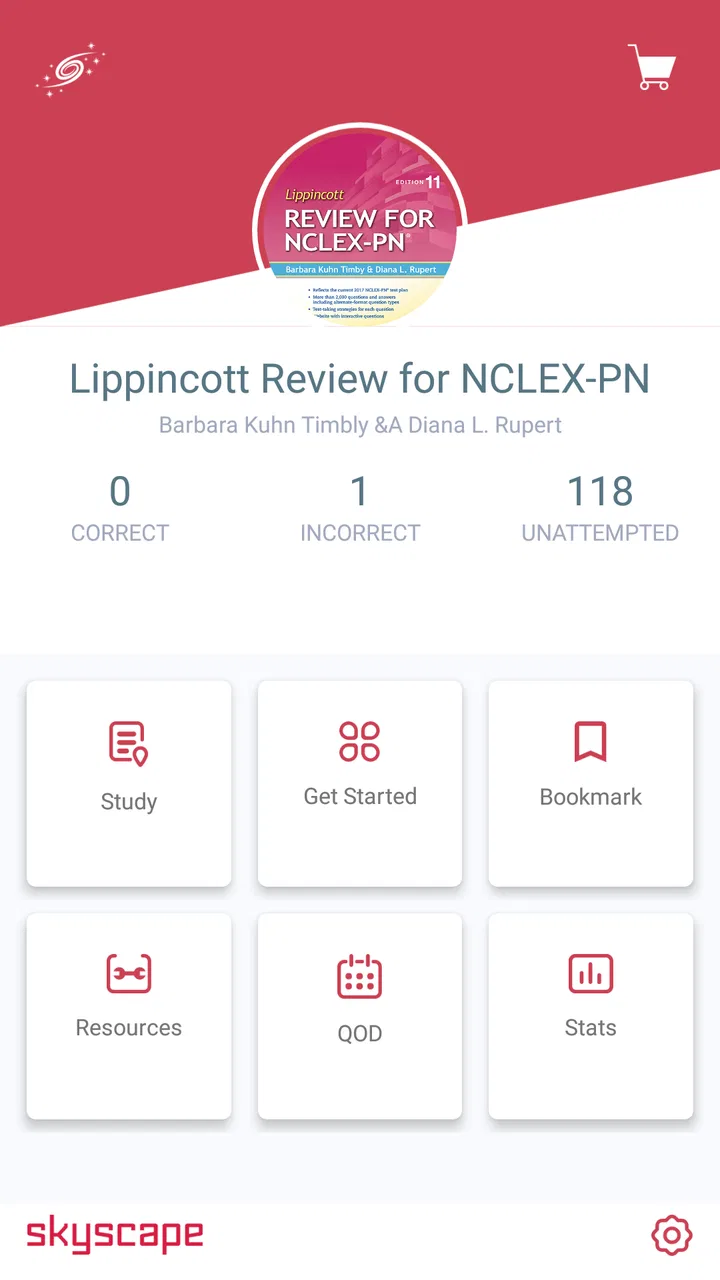
Lippincott Review for NCLEX-PN
- 4.7
- Rating
- 10.00K
- Installs
- Free
- Price
 Analysis by App-foxy
Preparing for the NCLEX-PN can feel less like studying a normal subject and more like learning how to make safe decisions when several answers look reasonable. That is where Lippincott Review for NCLEX-PN fits into my routine. It is a medical study app from Skyscape Medpresso Inc, built around practice questions rather than long lessons. I found it most useful when I already understood the basic nursing material and needed a focused way to test judgment, identify weak areas, and review the reasoning behind an answer.
The app is free to install and is suitable for Everyone, although some of its study content is offered through in-app purchases ranging from $22.99 to $44.99 per item. It has a 4.7 average from 121 ratings and has passed 10K+ installs, which gives it a modest but reassuring presence among nursing exam tools. Its current version is 4.16.0, and it runs on Android 5.0 or later. Those details matter less than the actual study flow, so I paid closest attention to what happens from the moment I open a question to the point where I turn a wrong answer into a useful revision task.
How a short study session actually unfolds
I use a short session to test one specific skill, not to chase a high question count. Before I begin, I choose a focus—such as deciding what needs attention first—and keep a note of any uncertainty to revisit later. That small boundary makes the practice more deliberate and sets up a closer look at how to read each question.
You May Also Like

 Pandora - Music & Podcasts
Pandora’s Music Is Easy to Start, but Harder to Recover
Pandora’s strength is its low-effort path from a seed to a station. Its weak spot is how much confidence it asks you to place in connection, setup, and quiet recovery.

 8 Ball Pool
 Is Built on Rivalries, Rematches, and Routine
A close look at the rivalries, rematches, shared routines, and unanswered safety questions that turn a quick pool match into a persistent mobile community.

 Samsung Music
’s Quiet Strength Is Playing What You Already Own
Its reach comes less from spectacle than from dependable access to a personal library. That simplicity is both the app’s strongest retention engine and its ceiling.

 AccuWeather: Weather Radar
AccuWeather Review: A Quick, Clear Forecast for Everyday Decisions
For everyday plans, the best forecast is the one you can understand quickly. AccuWeather makes rain timing, radar, and local conditions easy to act on, with a few trade-offs.

 Hill Climb Racing
Why Hill Climb Racing Still Turns Crashes Into One More Run
A tiny car, a bumpy hill and one more upgrade: Hill Climb Racing keeps resurfacing because its simple chaos makes every near-miss feel personal.

 AliExpress - Shopping App
AliExpress Makes Global Shopping Feel Personal, but Shoppers Bear the Risk
AliExpress turns a global marketplace into a pocket-sized discovery engine. Its reach is useful, its shopping loop compelling, and its trade-offs easy to miss.
More From Our News Desk
View All News


Starting with a clear problem instead of opening a textbook
My best sessions began with a specific starting condition: I knew I had limited time and did not want to reread an entire chapter. The app’s central promise is a bank of 2000 questions with rationale, and that makes it naturally suited to targeted practice. Rather than asking me to decide which paragraph of a textbook deserves attention, it puts a clinical decision in front of me and makes me commit to an answer.
That distinction is important. A textbook is better when I need to build a topic from the ground up. This app is better when I need to discover whether I can recognize the priority, interpret the wording, and select the safest nursing action under exam pressure. I would not use it as my only source during the first pass through pharmacology or adult health. I would use it after learning the material, when passive familiarity needs to become active recall.
A realistic example is a short evening session after clinical placement. I might have twenty minutes before dinner and feel that I spent the day seeing many conditions without truly organizing them. Opening a question bank gives that time a defined outcome. I answer a small group, flag the items that exposed uncertainty, and leave with a short list of topics to revisit instead of the vague feeling that I should study everything.
Moving through a question without rushing the wording
The most valuable habit I developed was reading the question as a handoff, not as a trivia prompt. I first identify the patient problem, then look for words that establish urgency, change, or risk. Only after that do I compare the options. This prevents me from choosing an intervention simply because it sounds familiar.
That approach works especially well for practical-nursing preparation, where the difference between two answers may depend on assessment, prioritization, delegation, or immediate safety. I try to explain my choice to myself before checking the result. If I cannot state why the selected action comes first, a correct answer may be luck rather than knowledge.
The app becomes much more useful when I resist the temptation to treat each item as a score-producing event. A quick tap followed by a quick glance at the answer can create false confidence. I prefer to pause after every difficult question and predict what the rationale will emphasize. That small delay turns the exercise into clinical reasoning practice rather than simple recognition.
Using the rationale as the real lesson
The answer itself is only the midpoint. The rationale is where I decide whether my mistake came from missing a fact, misreading the priority, overlooking a safety issue, or being distracted by an attractive but secondary intervention. Those are different problems and require different follow-up.
The practical value is not merely knowing which option is correct; it is learning why the other options should wait, change, or be rejected. I found this especially helpful with questions that contain several actions a nurse might eventually perform. The rationale can help separate the first action from a later action, or an appropriate response from one that is unsafe in the current situation.
My preferred workflow is to write a very short note after a wrong answer: “missed priority,” “forgot contraindication,” or “need to review finding.” I do not copy the entire explanation. The point is to preserve the reason I failed so that my later textbook review is precise. This is one of the less obvious ways to get more from a question bank: use it to direct reading, rather than opening a book randomly after every mistake.
Turning individual misses into a study handoff
A question bank is often used alone, but the information it produces can be handed off to other study tools. When I notice repeated uncertainty around a subject, I move that subject into a separate review block. For example, if several questions reveal confusion about medication safety, I stop doing more random questions and revisit the relevant drug classes, adverse effects, and nursing assessments in a trusted reference.
This handoff prevents a common failure pattern: answering dozens of questions about the same weakness without repairing the weakness. More exposure is not automatically more learning. Sometimes the correct next step is to leave the app, study the underlying concept, and return later to see whether the reasoning has improved.
The same method works for a study partner. Instead of saying, “I got this one wrong,” I can explain the patient situation, my original reasoning, and the point at which the rationale changed my view. That creates a useful conversation about priorities and safety rather than a simple exchange of answer letters. It also reveals whether I truly understand the rationale or merely recognize it after seeing it.
What the result looks like after a session
The result I want from a session is not a perfect run. It is a clearer map of my decision-making. A productive session tells me whether I am weak in content, question interpretation, or prioritization. Those distinctions help me plan the next hour far better than a single percentage would.
For instance, I may know the signs of a complication but still choose the wrong intervention because I fail to identify which finding is most urgent. In that case, reviewing more definitions will not solve the problem. I need to practice recognizing deterioration and ranking actions. The app’s question-and-rationale format makes that gap visible when I examine why my answer was tempting but not best.
I also like using a final question as a verbal recap. After finishing, I explain one missed item without looking at the screen: what the patient’s immediate concern was, what the nurse should do first, and why the alternatives were less appropriate. If I cannot do that, I mark the topic for another review cycle. This simple handoff from screen to memory is a stronger test than rereading the explanation.
Where the workflow becomes less comfortable
The focused format has limits. A large question collection can encourage quantity over depth, especially when I am tired or anxious about progress. It is easy to mistake completing more items for becoming more prepared. The app cannot decide whether I have built a balanced study plan across all required nursing areas, so that responsibility remains with me.
Another friction point is the boundary between practice and instruction. Someone who is new to a topic may find a rationale helpful but still need a fuller lesson, diagrams, demonstrations, or instructor guidance. A brief explanation attached to a question cannot replace a structured course when the underlying concept is unfamiliar.
The purchase structure also deserves attention before committing to a long-term plan. The app is free to install, but individual in-app items cost between $22.99 and $44.99. I would first explore the available free portion and decide whether the question style suits me before paying. That is particularly important for students who already have access to a school question bank and do not want overlapping material.
There is also a personal-device consideration. The minimum operating-system requirement is Android 5.0, so many older devices can run it, but compatibility alone does not guarantee a comfortable study experience. I would check how easily I can read explanations on my phone and whether the app fits my preferred note-taking method. A question bank is only useful if reviewing the rationale is convenient enough that I actually do it.
Who should use it, and who should choose another route
I would recommend this app to an LPN or practical-nursing student who has already covered core material and wants repeated exposure to exam-style decisions. It is also a good fit for someone who studies in short blocks: between classes, during a commute as a passenger, or in the final part of an evening when a full chapter feels unrealistic. The compact question format makes it easier to start than a large reference book.
I would be more cautious about recommending it to a beginner who expects a complete nursing curriculum. That student may need lectures, organized chapters, instructor feedback, and visual explanations before question practice becomes efficient. I would also hesitate if the main goal is a broad clinical reference for use during patient care. This is a review tool for exam preparation, not a substitute for institutional guidance, current clinical policies, or professional judgment.
Compared with a printed review book, the app is more convenient for quick testing and easier to fit into spare moments. The book may be preferable for people who annotate heavily, dislike phone distractions, or want to see a topic arranged as a continuous chapter. Compared with a general flashcard app, this resource has a stronger emphasis on complete clinical scenarios and rationales. Flashcards can be faster for memorizing isolated facts, while these questions are better for practicing the decision that connects several facts.
Compared with a full online NCLEX course, it is narrower and less guided. A course may provide a schedule, video teaching, readiness tracking, and instructor-led explanations. This app is more self-directed. That can be a strength for an experienced learner who knows what to review, but a weakness for anyone who needs an external plan and regular accountability.
Small techniques that make the question bank more effective
First, I separate content errors from process errors. If I did not know the medication effect, I review the medication. If I knew the effect but ignored the word “first,” I practice prioritization. This prevents me from labeling every wrong answer as a general knowledge problem.
Second, I revisit correct answers that felt uncertain. A correct guess can hide the same weakness as an incorrect answer, and it is often more dangerous because it feels reassuring. I make a mental note whenever I selected an option by elimination without understanding the clinical reason.
Third, I alternate between fresh questions and delayed explanation. On one pass, I answer and study the rationale immediately. On another, I record only the topic of the mistake and return later to explain it from memory before checking the reasoning again. The delayed pass exposes whether the lesson stayed with me after the screen was closed.
Finally, I avoid using the app immediately after reading the exact same material. A short gap gives a more honest test of recall. If I answer questions directly after studying a chapter, recognition can make me feel more prepared than I am. Returning later creates a better handoff from learning to retrieval.
My recommendation after following the full workflow
Lippincott Review for NCLEX-PN works best as a structured checkpoint in a larger preparation plan. I open it with a defined weakness or a limited study window, answer carefully, inspect the rationale, and transfer repeated problems into textbook review or discussion with a teacher or study partner. The outcome is useful when I treat every explanation as evidence about my reasoning, not just as a correction.
Its free entry point makes it easy to try, and the medical focus is clear from the first session. The developer, Skyscape Medpresso Inc, has positioned it as a practical review companion rather than an all-purpose nursing school replacement. Its 4.7 average and 10K+ installs suggest that it has found an audience, but those figures should not decide whether it fits your preparation style.
My honest view is that this is a strong choice for targeted practice, especially when I need to turn passive knowledge into safer exam decisions. I would pair it with comprehensive teaching resources, current nursing references, and a personal error log. If you want a complete course, dislike studying from a phone, or need detailed instruction before attempting questions, another option will serve you better. If you already know the basics and want rationales that make you defend each choice, this app can become a useful part of the route from uncertainty to exam readiness.
FAQs for Lippincott Review for NCLEX-PN
01What is Lippincott Review for NCLEX-PN?
Lippincott Review for NCLEX-PN is a nursing exam preparation app designed for students preparing for the NCLEX-PN licensing examination. It provides practice questions, answer explanations, and review material focused on practical nursing topics. The app is intended to help users become familiar with NCLEX-style questions, identify weak areas, and build confidence through repeated study sessions.
02What kind of study content does the app include?
The app generally focuses on practice-based preparation, offering NCLEX-PN-style questions across important nursing categories such as pharmacology, fundamentals, medical-surgical care, maternal and child health, mental health, and client needs. Detailed rationales are especially useful because they explain why an answer is correct and help clarify the clinical reasoning behind each question.
03Can I use Lippincott Review for NCLEX-PN without an internet connection?
Offline access may depend on the specific version, subscription, and content downloaded to the device. Some features may work after study materials are saved locally, while account verification, updates, synchronization, or certain resources can require an internet connection. Before relying on the app during travel or in areas with limited service, test the desired features offline.
04Is Lippincott Review for NCLEX-PN free to download?
The app may be available to download at no initial cost, but access to its complete question bank or premium review content can require a purchase, subscription, activation code, or access provided through an educational institution. Pricing and included features may vary by platform and region, so prospective users should check the current store listing before downloading.
05Is this app enough to prepare for the NCLEX-PN by itself?
Lippincott Review for NCLEX-PN can be a valuable practice and revision tool, but it should not usually be treated as a complete replacement for a structured nursing review course, textbooks, instructor guidance, or official examination information. The best results come from combining its questions and rationales with content review, timed practice, clinical judgment preparation, and a consistent study schedule.
Pros
- Focused NCLEX-PN content makes study sessions easier to organize.
- Practice questions help reinforce clinical reasoning and test-taking skills.
- Useful for reviewing key nursing concepts during short study breaks.
- Explanations can clarify why an answer is correct or incorrect.
- Portable format supports studying without carrying a printed review book.
Cons
- The app may feel overwhelming for beginners without basic nursing knowledge.
- Some users may prefer more interactive lessons than question-based review.
- Practice questions should not replace official NCLEX test-plan preparation.
- A subscription or purchase may be required for full access to all content.
- Content updates may be needed to reflect changes in nursing standards and exams.

Lippincott Review for NCLEX-PN
Gallery